


Your shopping cart is empty!
Broad beans "Joker" (500 g)
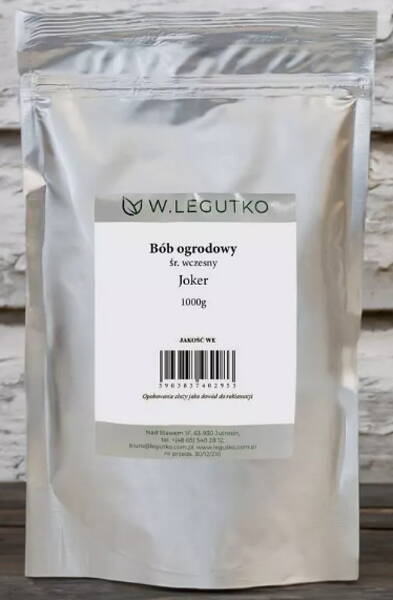
Prof Pack
New
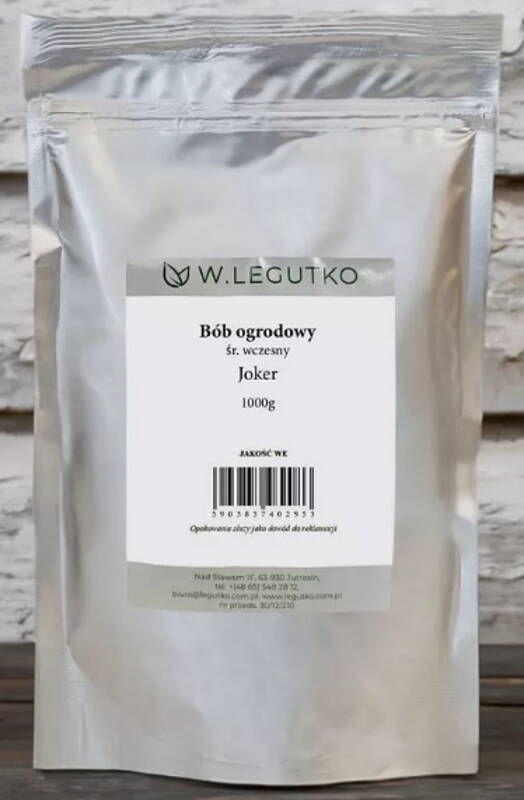
Broad beans "Joker".
An early and very high-yielding variety that produces exceptionally large and tasty seeds, which are perfect both for fresh consumption and for all types of processing. The variety has high resistance to viral diseases and low temperatures. Recommended for growing under covers.
An early and very high-yielding variety that produces exceptionally large and tasty seeds, which are perfect both for fresh consumption and for all types of processing. The variety has high resistance to viral diseases and low temperatures. Recommended for growing under covers.
Technical characteristics.
-
Location: sunny.
-
Sowing time in open ground: March, April, May.
-
Planting scheme: 20 cm x 45 cm.
-
Number of seeds per gram (average): 0.7 pieces.
* Obtaining your own seeds.
Attention ! Broad beans are prone to cross-pollination, so when propagating two or more varieties, observe spatial isolation. Due to the limited size of the plot, the gardener often has to be satisfied with one variety for this reason. The shelf life of seeds is 10-12 years (however, good seed germination is maintained for no more than 4-5 years).
The pollen of vegetable beans is carried by honey bees and bumblebees. Harvesting for seeds begins when the lower pods turn black. The stems are pulled out and ripened in sheaves. Threshing is done manually, shelling the seeds from the pods.
Beans and seeds in the milky ripeness stage are used for canning, freezing, and in cooking.
For the harvest to be continuous over a long time, sowing is carried out in several stages. Sowing in open ground is carried out in late April – early May, to a depth of 5 cm. Sowing scheme: 20x60 cm.
Broad beans prefer moist, peaty-marshy, and heavy clay soils. Seed yield is 0.4-0.5 kg/m2.
In terms of calories, bean seeds exceed potatoes by 3 times. Harvesting begins depending on the intended use of the product: if the fruits are intended to be eaten whole (grains with pods), they are harvested when the pods are juicy and the grains reach 1 cm in diameter.
If the grown grains are to be eaten raw, the beans are harvested when the seeds are in the phase of milky ripeness and reach the maximum size for this variety.
The crop is harvested in 3-4 stages with intervals of 8-10 days. The pods are broken off by hand, trying not to damage the plant.
The yield of unripe pods averages about 1 kg, and unripe grains — 0.4 kg per 1 sq. m. If the crop is harvested once, you can cut all the plants (or pull them out by the roots), tie them into sheaves, and dry them well. After the plants have dried, the beans must be separated and threshed. Then dry them completely and put them for storage in a dry, dark place in cloth or paper bags. Black beans are stored for a long time without losing their qualities and germination.
* In terms of protein and amino acid content, broad beans surpass peas. Broad bean protein is equal in value to meat protein. Its seeds contain 28-35% protein, and, importantly, many essential amino acids that the human body receives only with food and does not produce on its own.
In the phase of technical ripeness, beans contain 4.2% carbohydrates, 2.6% of which are sugars, as well as a large amount of mineral salts, mainly potassium, calcium, phosphorus, magnesium, sulfur, iron; up to 36% starch, 4% pectin substances and up to 15% fat. Green beans contain many trace elements, as well as enzymes. They have a large amount of vitamin C – 20 mg%, vitamin PP – 1.8 mg and carotene (provitamin A) – 0.5 mg.
Broad beans are demanding on soils. Sandy loams are of little use for their cultivation. But on peaty-marshy and heavy clay soils, beans grow well, especially the variety "Russian Black" — one of the oldest zoned varieties. But liming is required, the variety succeeds better on soils with a neutral reaction of the soil solution. And it is even better to use wood ash for these purposes.
In the area allocated for beans, we dig up the soil in the autumn, to the depth of a spade bayonet (20 cm), and in the spring we apply organic and mineral fertilizers: humus (compost), manure (if you have it) – 5 kg per 1 m2, superphosphate 30-50 g, potassium chloride (from autumn) – 10-20 g.
If in the fall we fertilized the soil well when digging the beds, then in the spring we apply only a garden mixture – 30 g/m2 and 2 glasses of wood ash per 1 m2. We sow beans at the earliest possible date (they belong to the most cold-resistant plants), usually in late April – early May.
Care for crops: loosening row spacings, weeding with simultaneous destruction of weeds. During repeated loosening, we hill up the plants. To reduce the growing season and ensure friendly ripening of beans, as well as a measure against aphids, during the mass flowering period, we carry out topping – removing the top of the main stem.
We harvest beans for seeds when 75-90% of them turn black. With a knife or sickle, we cut the plants and tie them into sheaves. We hang the sheaves indoors, but under no circumstances under a canopy or in an open room where birds can fly in, as you can lose the entire crop...
Drying lasts 7-10 days. After drying, we thresh the beans. We store the seeds in a dry room.